PTO Maxxing: How to Turn 15 Vacation Days Into 49+ Days Off in 2026 & 2027
PTO maxxing (also called vacation maxing or holiday maxxing) turns a small PTO budget into long stretches off around public holidays and weekends.

What Is PTO Maxxing?
PTO maxxing is the practice of strategically placing your paid time off around public holidays and weekends to turn a small number of vacation days into long stretches of consecutive time off.
The idea is simple: holidays and weekends are days you already have off. If you place your paid vacation days in the narrow gaps between them, each PTO day you spend can buy you two, three, or even four total days off. Instead of taking a random Tuesday in March, you take the four working days between a Thursday holiday and the following weekend — and turn one holiday into a nine-day break.
The term shows up with a few different spellings, and they all mean the same thing. You'll see it written as PTO maxxing, PTO-maxxing, and PTO maxing, and the same approach is sometimes called vacation maxxing or holiday maxxing. Whichever spelling you use, the strategy is identical: maximize the return on every vacation day by anchoring it to a holiday.
Want to skip the math? The Holiday Optimizer computes the best PTO placement for your country and PTO budget automatically. For full year-by-year dated tables, see the PTO calendar.
The Mechanic: Holiday Bridging
The engine behind PTO maxxing is a technique called holiday bridging — using PTO days to "bridge" the gap between a public holiday and your normal days off so the whole stretch becomes continuous.
Here's how bridging works in practice:
- A Monday holiday already gives you a three-day weekend (Saturday, Sunday, Monday). Add one PTO day on the following Friday and you have a four-day weekend for a single vacation day.
- A Thursday or Friday holiday sits right next to a weekend. Bridge the working days on the other side and a single holiday can anchor a full week or more off.
- Two holidays close together — like Christmas and New Year's Day — let you bridge the working days between them and the surrounding weekends, producing the longest break of the year for relatively few PTO days.
The math compounds. A holiday on its own is one day off. A holiday plus a weekend is three. A holiday, a weekend, and a few bridged PTO days can be nine or more. Stack this across every holiday on the calendar and a modest PTO budget stretches surprisingly far.
Day counts and prices in this guide are approximate. The exact dates that work for you depend on your country, your local public holidays, and which days your employer actually observes — always confirm them against your own calendar before requesting time off.
Worked Examples: PTO Maxxing in 2026 (US)
The clearest way to understand the mechanic is to see it applied. The table below uses real 2026 US holiday dates. Each row shows the PTO days you spend, the total days off you get, and the continuous window those days fall in.
| Holiday | Holiday date | PTO days to take | PTO spent | Total days off | Your window |
|---|---|---|---|---|---|
| Memorial Day | Mon, May 25 | May 26, 27, 28, 29 | 4 | 9 | May 23 – May 31 |
| Thanksgiving | Thu, Nov 26 | Nov 23, 24, 25, 27 | 4 | 9 | Nov 21 – Nov 29 |
| Christmas + New Year's | Fri, Dec 25 + Fri, Jan 1 | Dec 21–24 + Dec 28–31 | 8 | 16 | Dec 19 – Jan 3 |
A few things to notice:
- Memorial Day lands on a Monday. Bridging the four working days after it (Tuesday through Friday) connects two weekends into a single nine-day stretch for four PTO days.
- Thanksgiving lands on a Thursday. Take the three working days before it plus the Friday after (the day many people call the long Thanksgiving weekend) and four PTO days again buy you nine days off.
- Christmas and New Year's fall on consecutive Fridays in 2026, with New Year's Day landing on Friday, January 1, 2027. Bridging the working days around both holidays turns eight PTO days into a sixteen-day window that runs straight into the new year — your single biggest payoff of the season.
These three windows alone use 16 PTO days and produce 34 days off. They are meant to illustrate the mechanic, not to be the whole plan — see the next section for how the full-year total gets to 40-49+.
Many employers already give the day after Thanksgiving (Black Friday) off, and some shut down entirely between Christmas and New Year's. If yours does, you spend fewer PTO days for the same window — and you can redistribute the saved days to bridge another holiday.
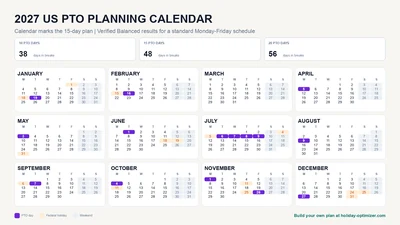
Beyond these three worked windows, here's what Holiday Optimizer's Balanced strategy actually selects for the full 2026 US federal holiday calendar at three common PTO allowances:
| PTO allowance | Days in breaks | Breaks | Longest | Days per PTO |
|---|---|---|---|---|
| 10 days | 38 | 10 | 4 days | 3.8× |
| 15 days | 48 | 12 | 9 days | 3.2× |
| 20 days | 56 | 11 | 9 days | 2.8× |
“Days in breaks” counts only the calendar days inside the optimizer's selected vacation windows—not every ordinary weekend in the year.
Exact 10-day PTO plan38 days inside 10 recommended breaks
PTO dates to request
- Jan 20
- Feb 17
- Apr 27
- May 26
- Jul 6
- Aug 10
- Sep 8
- Oct 13
- Nov 27
- Dec 28
Strongest opportunities
Jan 17–20
4 days off using 1 PTO
Feb 14–17
4 days off using 1 PTO
May 23–26
4 days off using 1 PTO
Exact 15-day PTO plan48 days inside 12 recommended breaks
PTO dates to request
- Jan 20
- Feb 17
- Mar 30
- Apr 27
- May 26
- Jun 29–Jul 2
- Aug 10
- Sep 8
- Oct 5
- Nov 2
- Nov 27
- Dec 28
Strongest opportunities
Jun 27–Jul 5
9 days off using 4 PTO
Jan 17–20
4 days off using 1 PTO
Feb 14–17
4 days off using 1 PTO
Exact 20-day PTO plan56 days inside 11 recommended breaks
PTO dates to request
- Jan 20
- Feb 17
- Mar 30
- Apr 27
- May 26
- Jul 6
- Aug 10
- Sep 8–11
- Oct 13
- Nov 9–10
- Nov 12–13
- Dec 21–24
Strongest opportunities
Sep 5–13
9 days off using 4 PTO
Nov 7–15
9 days off using 4 PTO
Dec 19–27
9 days off using 4 PTO
Last verified . Baseline: US federal holidays, a Monday–Friday workweek, Saturday–Sunday weekends, and no pre-booked or company-specific days. Confirm observed holidays with your employer. These totals assume the full January–December calendar; the live app always plans from today through the end of the year, so opening a 2026 plan there after some holidays have already passed will return a smaller total than shown above.
Download the data (CSV)Holiday calendar references: U.S. Office of Personnel Management. Holiday data is derived from date-holidays under CC BY-SA 3.0. See the calculation methodology.
How a Small PTO Budget Becomes 40-49+ Days Off
The headline numbers come from applying holiday bridging across the entire year, not just one or two holidays. When you bridge every public holiday on the calendar — the Monday holidays that hand you free long weekends, the Thursday and Friday holidays you can extend into full weeks, and the year-end Christmas-to-New-Year's stretch — the totals add up fast.
In a typical US year, stacking PTO around the full slate of public holidays lets many workers turn roughly 15 to 17 PTO days into about 40 to 49 or more total days off. The exact figure depends on how the holidays fall that year and how many your employer observes, so treat it as an approximate ceiling rather than a guarantee.
This "15 vacation days into 49 days off" framing was popularized by Fortune in its May 27, 2026 article, What is PTO-maxxing? How to turn 15 vacation days into 49 days off in 2026 and 2027. The 49-day figure is the high end of what's possible in a favorable year; your own number will vary with your country, your PTO allowance, and your company's holiday calendar.
For a complete, dated US plan that builds eight bridged windows out of 15 PTO days, see our companion guide on how to turn 15 PTO days into 46 days off in 2026.
The same mechanic carries straight into 2027, though the holiday calendar shifts — several holidays land mid-week that year, so the cheapest bridges move. See our companion guide on maximizing PTO in 2027 for the dated plan, or compare the verified numbers directly:
| PTO allowance | Days in breaks | Breaks | Longest | Days per PTO |
|---|---|---|---|---|
| 10 days | 38 | 10 | 4 days | 3.8× |
| 15 days | 48 | 12 | 9 days | 3.2× |
| 20 days | 56 | 11 | 9 days | 2.8× |
“Days in breaks” counts only the calendar days inside the optimizer's selected vacation windows—not every ordinary weekend in the year.
Exact 10-day PTO plan38 days inside 10 recommended breaks
PTO dates to request
- Jan 19
- Feb 16
- May 3
- Jun 1
- Jul 6
- Aug 9
- Sep 7
- Oct 12
- Nov 26
- Dec 27
Strongest opportunities
Jan 16–19
4 days off using 1 PTO
Feb 13–16
4 days off using 1 PTO
May 29–Jun 1
4 days off using 1 PTO
Exact 15-day PTO plan48 days inside 12 recommended breaks
PTO dates to request
- Jan 19
- Feb 16
- Apr 5
- May 3
- Jun 1
- Jul 6–9
- Aug 9
- Sep 7
- Oct 4
- Nov 1
- Nov 26
- Dec 27
Strongest opportunities
Jul 3–11
9 days off using 4 PTO
Jan 16–19
4 days off using 1 PTO
Feb 13–16
4 days off using 1 PTO
Exact 20-day PTO plan56 days inside 11 recommended breaks
PTO dates to request
- Jan 19
- Feb 16
- Apr 5
- May 3
- Jun 1
- Jul 6
- Aug 9
- Sep 7–10
- Oct 12
- Nov 8–10
- Nov 12
- Dec 20–23
Strongest opportunities
Sep 4–12
9 days off using 4 PTO
Nov 6–14
9 days off using 4 PTO
Dec 18–26
9 days off using 4 PTO
Last verified . Baseline: US federal holidays, a Monday–Friday workweek, Saturday–Sunday weekends, and no pre-booked or company-specific days. Confirm observed holidays with your employer.
Download the data (CSV)Holiday calendar references: U.S. Office of Personnel Management. Holiday data is derived from date-holidays under CC BY-SA 3.0. See the calculation methodology.
Does PTO Maxxing Work Outside the US?
Yes — the mechanic is country-agnostic. Any calendar with public holidays and weekends can be bridged. What changes is which holidays exist and how they fall.
- Canada has provincial and federal statutory holidays that vary by province.
- The UK has bank holidays clustered in spring and around Christmas.
- Australia has national and state public holidays, with several long-weekend candidates.
The PTO calendar has full dated tables for the US, Canada, UK, and Australia so you can see exactly which days to bridge in each country, for 2026 and beyond. If you'd rather not work from a table, the Holiday Optimizer takes your country, your PTO budget, and your preferred break style and computes the optimal placement for you.
Common PTO Maxxing Mistakes
The strategy is straightforward, but a few habits quietly waste days:
- Requesting too late. The best bridged windows are the most contested. Coworkers want the Thanksgiving week and the Christmas stretch too. Submit early — ideally plan the whole year at once — so you're first in line.
- Counting holidays your employer doesn't observe. Not every public holiday is a company holiday. Bridging a "holiday" your office actually works through just means you took an ordinary day off. Confirm your company's observed list first.
- Ignoring company shutdowns. If your employer closes between Christmas and New Year's, those days are effectively free. Don't spend PTO on them — redirect those days to bridge a different holiday.
- Bridging in the wrong direction. For a Friday holiday, the working days to bridge are the Monday through Thursday before it, not the week after. Getting the side wrong breaks the continuous stretch.
- Over-optimizing for length. A single 16-day block isn't always better than several shorter breaks. Match the plan to how you actually like to rest — the Holiday Optimizer lets you choose a break style instead of just maximizing one window.
Quick Takeaways
- PTO maxxing (also written PTO-maxxing, PTO maxing, vacation maxxing, or holiday maxxing) means placing vacation days around holidays and weekends to maximize consecutive time off.
- The mechanic is holiday bridging: spend PTO on the working days between a holiday and your weekend to make the whole stretch continuous.
- A Monday holiday plus one Friday PTO day equals a four-day weekend. A Thursday or Friday holiday can anchor a full week.
- In 2026, Memorial Day and Thanksgiving each turn 4 PTO days into 9 days off; Christmas + New Year's turns 8 PTO days into a 16-day window running into 2027.
- Stacked across the whole year, roughly 15-17 PTO days can become about 40-49+ days off — Fortune popularized the "15 days into 49 days off" framing.
- Exact dates depend on your country and employer — confirm them before you request time off.
- Use the Holiday Optimizer and the PTO calendar to plan your own windows.
Conclusion
PTO maxxing isn't a loophole or a hack that games your employer — it's just being deliberate about when you spend the vacation days you've already earned. The same 15 days produce a forgettable scattering of long weekends if you place them randomly, or a year full of real breaks if you bridge them around holidays.
Start by looking at how your holidays fall this year, find the Monday holidays and the Thursday-and-Friday holidays, and bridge the gaps. The numbers do the rest. Just remember the totals here are approximate and US-anchored — your own calendar is the one that matters, so confirm the dates that apply to you.
Ready to maximize your time off?
See exactly which days to take off for your PTO maxxing plan
Frequently Asked Questions
-
What is PTO maxxing in one sentence? PTO maxxing is the practice of placing your paid time off immediately around public holidays and weekends so that a small number of vacation days produces a much larger number of consecutive days off.
-
Is it spelled PTO maxxing or PTO maxing? Both are used, along with PTO-maxxing. The double-x "maxxing" spelling is the most common online, but PTO maxing, vacation maxxing, and holiday maxxing all refer to the same strategy. There's no official spelling.
-
Can I really turn 15 vacation days into 49 days off? It's possible in a favorable year, which is the framing Fortune popularized in May 2026. The exact total depends on how the holidays fall and how many your employer observes. A realistic range for many US workers is about 40 to 49 or more total days off from roughly 15 to 17 PTO days. Treat it as approximate.
-
Does PTO maxxing work in countries outside the US? Yes. Holiday bridging works anywhere there are public holidays and weekends. Only the specific dates change. See the PTO calendar for dated US, Canada, UK, and Australia tables.
-
Do I have to use all my PTO at once to do this? No. PTO maxxing spreads your days across the year, anchored to different holidays, so you get several breaks rather than one. You choose how to weight it — a few big windows, many long weekends, or a mix. The Holiday Optimizer lets you pick a break style and adjusts the plan accordingly.
-
What is a "bridge day"? A bridge day is a single working day — usually sandwiched between a public holiday and a weekend — that you take off to connect the two into one longer break. It's the individual unit of holiday bridging: a Thursday holiday plus a Friday bridge day turns two days off into a four-day weekend for one day of PTO.
Share Your Thoughts
Have you tried PTO maxxing, or found a holiday bridge in your country's calendar that we should know about? Share this guide with a coworker who leaves vacation days on the table every year — and let us know how many days off you managed to unlock.