How to Maximize PTO on a 9/80 Work Schedule
A practical PTO planning method for a 9/80 schedule: model alternating Fridays off, combine them with holidays, and avoid spending PTO on days you already have free.

On a 9/80 schedule, your biggest advantage is not a public holiday. It is the alternating weekday you already have off. The best PTO plan treats each scheduled Friday off as a free anchor and looks for holidays or PTO days that connect it to a longer break.
Holiday Optimizer does not currently have a dedicated “9/80” switch. For whole-day calendar planning, the practical workaround is to add each scheduled Friday off as a Company Day Off. That tells the algorithm the date is already free, so it will not spend PTO on it.
The U.S. Office of Personnel Management calls this a 5/4-9 compressed plan: a full-time employee works eight 9-hour days and one 8-hour day across a two-week, 80-hour pay period. Employer versions can differ, so the actual rotation and the way leave hours are charged must come from your workplace calendar.
What a 9/80 PTO opportunity looks like
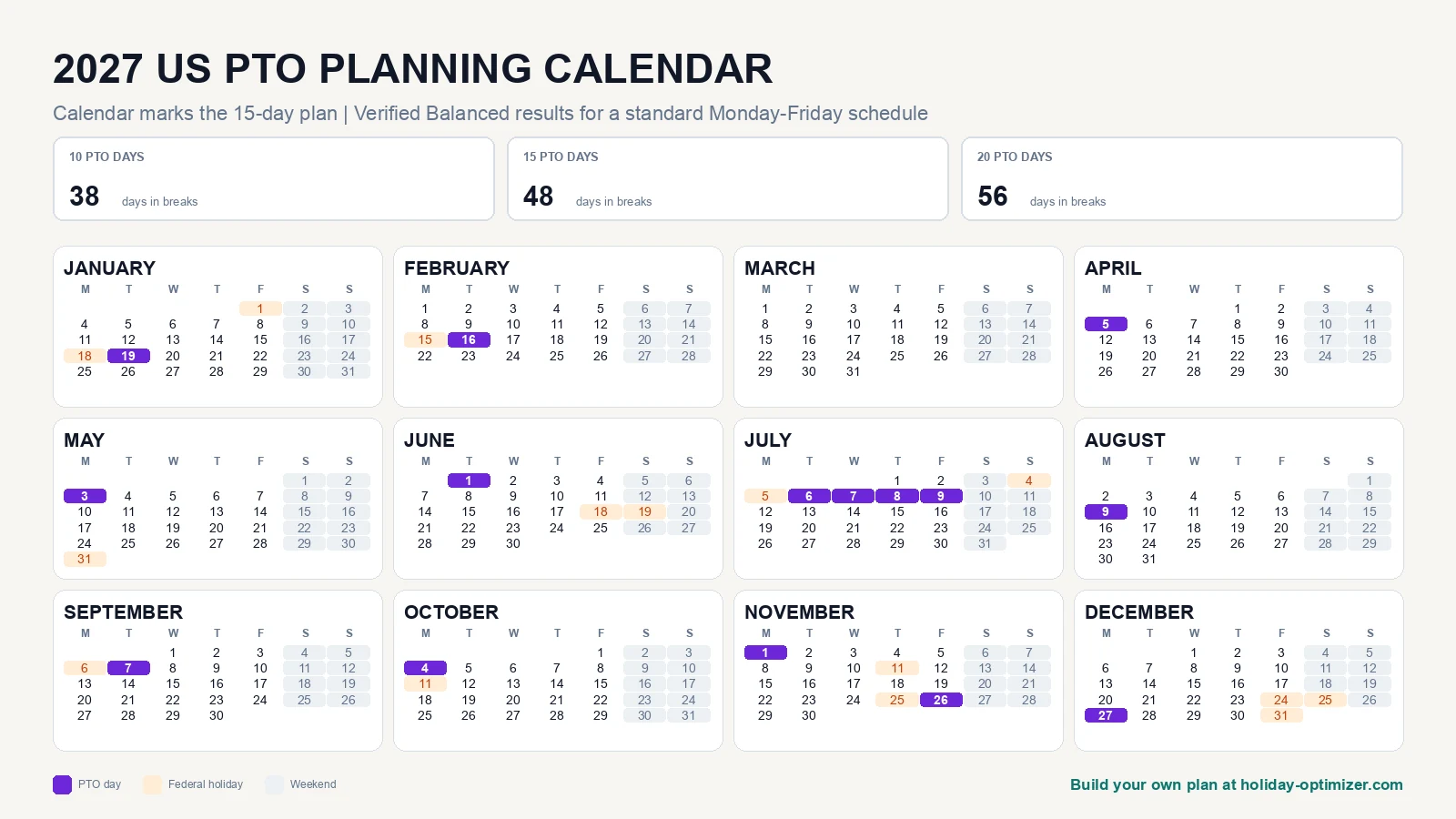
Suppose Friday, February 12 is your scheduled day off and Monday, February 15 is a public holiday:
| Day | Status |
|---|---|
| Friday, Feb 12 | Scheduled 9/80 day off |
| Saturday–Sunday | Weekend |
| Monday, Feb 15 | Public holiday |
That is already four days off with zero PTO. Taking Thursday, February 11 would create five days off for one PTO day. Taking Tuesday, February 16 would do the same on the other edge.
The valuable insight is that the scheduled Friday—not the PTO day—creates most of the leverage. Your PTO merely connects calendar blocks that are already free.
Set up a 9/80 calendar correctly
- Get the exact list of scheduled Fridays or Mondays you have off for the planning period.
- Enter your location and public holidays normally.
- Open Company Days Off and add every alternating off-day.
- Give them a recognizable name such as “9/80 Friday.”
- Keep Saturday and Sunday as your normal weekly days off.
- Enter your PTO allowance and run the optimizer.
Do not mark every Friday as a weekend day. That would describe a four-day workweek and incorrectly make all Fridays free. A 9/80 schedule alternates, so its off-days must be entered as specific dates.
Add the full year's alternating off-days before optimizing. Missing even one can make a proposed break look better or worse than it really is.
What this workaround does not model
The optimizer understands which dates are free, but it does not understand the full 9/80 pay-period structure. It will not generate alternating Fridays automatically or distinguish a nine-hour workday from an eight-hour workday. If your employer deducts PTO by the hour, use the result to choose promising dates, then confirm the actual hour cost in your leave system before requesting them.
This workaround also assumes you still have recurring weekly days off, usually Saturday and Sunday. The required weekend setting represents those weekly days; it does not turn your alternating Friday into a weekly weekend day.
The three patterns worth prioritizing
1. Scheduled Friday plus a Monday holiday
This is the cleanest result: a four-day break without spending PTO. If you need a longer trip, adding Thursday before or Tuesday after creates five days off for one PTO day.
2. Scheduled Friday beside a Thursday holiday
If Thursday is a holiday and Friday is already your 9/80 day off, you also receive four consecutive days without PTO. This is why your individual off-Friday rotation matters more than a generic holiday list.
3. A full week containing your off-Friday
For a Monday-to-Sunday break, an off-Friday reduces the usual five-PTO cost to four. Add a public holiday in the same week and the cost can drop to three.
Avoid the parity trap
Two people at the same employer may have opposite Friday rotations. A guide that says “take Thursday before Presidents' Day” can be right for one group and wrong for another. Never copy a 9/80 recommendation until you check which rotation applies to you.
The rotation can also shift around holiday weeks. Some organizations move the regular day off; others keep it fixed. Use the dates shown in your employer's calendar rather than projecting every second Friday indefinitely.
Which planning style works best?
- Balanced is a sensible default when you want a mixture of short resets and travel-sized breaks.
- Long Weekends works well when your goal is to turn off-Fridays into frequent four- or five-day breaks.
- Week-Long is better when you want the algorithm to spend your allowance on fewer, longer trips.
Start with the style that reflects your actual preference. The highest numerical total is not automatically the best plan if it produces a calendar full of breaks you would never use.
Ready to maximize your time off?
Build a plan around my 9/80 off-days
Sources and scope
- U.S. Office of Personnel Management: Alternative Work Schedules — includes the official 5/4-9 compressed-plan model and four-day-workweek examples for federal schedules.
- U.S. Office of Personnel Management: Compressed Work Schedules — explains the 80-hour biweekly requirement, fixed schedules, and holiday treatment for covered federal employees.
- U.S. Department of Labor: Vacations — explains that U.S. federal law generally leaves vacation and holiday benefits to employer or collective-bargaining agreements.
The OPM sources describe U.S. federal work schedules, not every private employer. This guide uses them to define the schedule pattern; your employer's policy controls the rotation, PTO-hour cost, holiday changes, and approval rules.
Frequently Asked Questions
What is a 9/80 work schedule?
A common 9/80 arrangement fits 80 working hours into nine days across two weeks, creating one recurring weekday off every other week. Exact hours and off-days vary by employer.
Should I select Friday as a weekend day for a 9/80 schedule?
No. That would make every Friday free. Keep your recurring weekend days selected, then enter each alternating Friday as a dated Company Day Off.
Does Holiday Optimizer fully support 9/80 schedules?
Not natively. Adding each off-Friday as a Company Day Off accurately models which whole dates are free, but the optimizer does not generate the two-week rotation or calculate different PTO-hour costs for eight- and nine-hour workdays.
Can a 9/80 day off combine with a public holiday?
Yes. A Friday off followed by a Monday holiday—or a Thursday holiday followed by a Friday off—can create four days off without using PTO.
What if my employer moves the off-Friday during holiday weeks?
Enter the employer's actual schedule. Do not rely on a simple every-other-Friday calculation when the rotation can change.