PTO Planning for a Fiscal Year or Non-Calendar Reset
Build a PTO plan around an April, July, anniversary, or other non-calendar-year reset without losing days at the allowance deadline.

If your PTO resets outside January, a January-to-December plan is the wrong optimization window. The correct approach is to model the 12-month period in which the allowance can actually be spent—for example, April 1 through March 31.
Holiday Optimizer supports this with the 12-Month Period option. Choose the starting month and year, then enter only the PTO days available during that period.
Why the reset date changes the answer
Imagine 15 PTO days expire on March 31. A calendar-year planner may save several days for summer even though those days disappear before summer arrives. It may also split the Christmas-to-New-Year holiday cluster across two artificial budgets.
A fiscal-year plan keeps every recommendation inside one entitlement window. It answers three practical questions:
- Which days should be used before the reset?
- Which holiday clusters belong to the current allowance?
- How much should remain uncommitted for the final quarter?
Set up a non-calendar PTO year
- Select 12-Month Period under Select Your Timeframe.
- Choose the month your allowance begins.
- Choose the starting year.
- Enter the PTO balance available for that exact period.
- Add company shutdowns and pre-booked leave within the same dates.
- Run the optimizer and compare the recommendations with carryover rules.
For an April 2027 reset, select April 2027. The tool will plan through March 31, 2028. An anniversary-based plan works the same way when the anniversary begins on the first of a month. If your policy resets mid-month, use the closest 12-month view as a planning aid and manually verify the boundary dates.
How the Reset Month Changes the Same Allowance
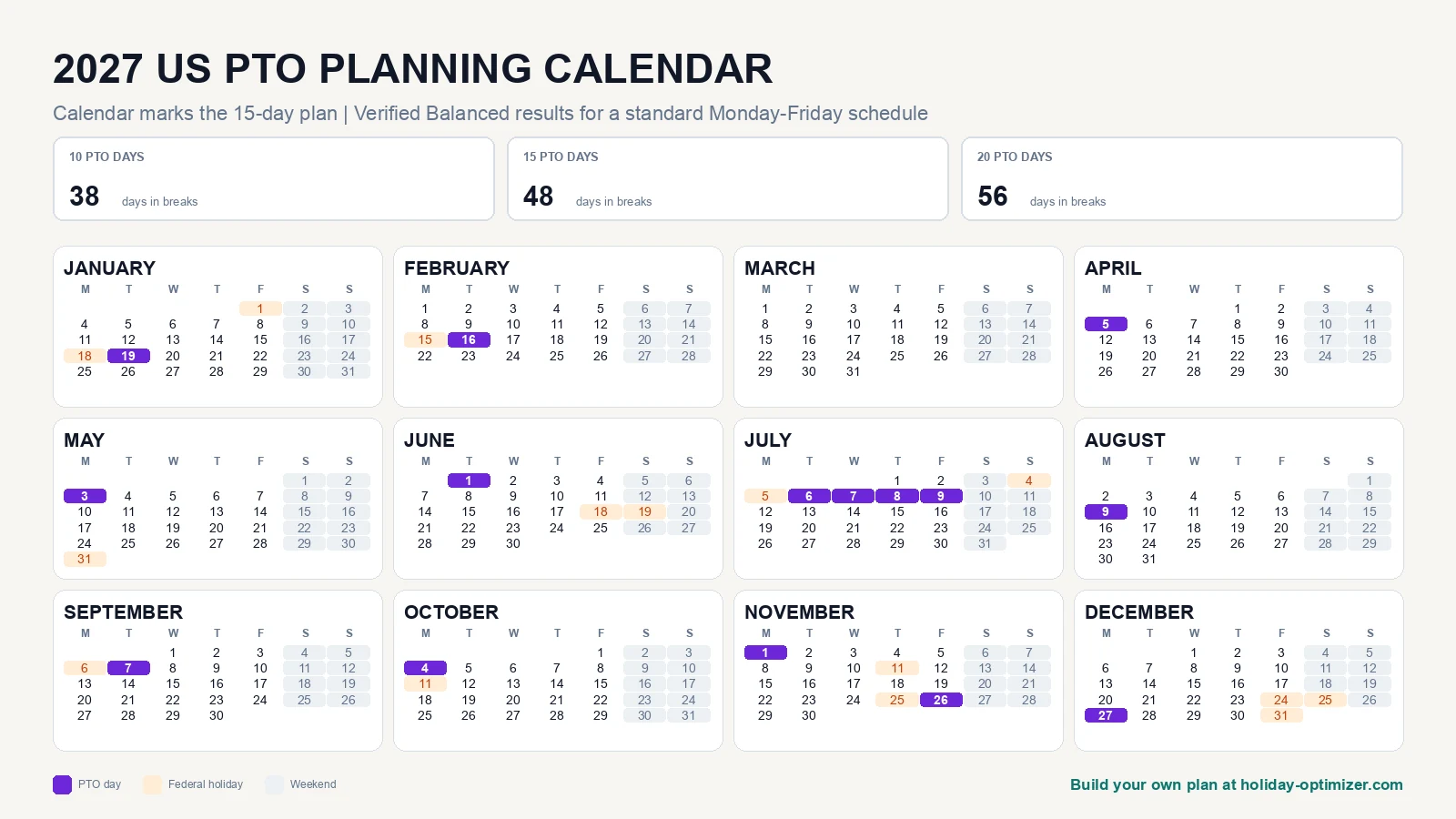
To show what actually changes when your entitlement window shifts, we ran Holiday Optimizer's Balanced strategy against the real 2027 (and, where the window crosses into the next year, 2028) US federal holiday calendar for a fixed 15-day allowance, starting the 12-month window in January, April, July, and October 2027. The January window is the same one used in our 2027 US PTO guide; the other three shift the same 15 days across a different set of holidays and land on a different total.
| Reset month | Window | Days in breaks | Breaks | Longest | Days per PTO |
|---|---|---|---|---|---|
| January | Jan 2027–Dec 2027 | 48 | 12 | 9 days | 3.2× |
| April | Apr 2027–Mar 2028 | 48 | 12 | 9 days | 3.2× |
| July | Jul 2027–Jun 2028 | 48 | 12 | 9 days | 3.2× |
| October | Oct 2027–Sep 2028 | 47 | 12 | 9 days | 3.1× |
Every row spends the same 15-day allowance across a different 12-month entitlement window—only the reset month changes. “Days in breaks” counts only the calendar days inside the optimizer's selected vacation windows, not every ordinary weekend in the period.
January reset: 15-day planJan 2027–Dec 2027 — 48 days inside 12 recommended breaks
PTO dates to request
- Jan 19
- Feb 16
- Apr 5
- May 3
- Jun 1
- Jul 6–9
- Aug 9
- Sep 7
- Oct 4
- Nov 1
- Nov 26
- Dec 27
Strongest opportunities
Jul 3–11
9 days off using 4 PTO
Jan 16–19
4 days off using 1 PTO
Feb 13–16
4 days off using 1 PTO
April reset: 15-day planApr 2027–Mar 2028 — 48 days inside 12 recommended breaks
PTO dates to request
- Apr 5
- May 3
- Jun 1
- Jul 6
- Aug 9
- Sep 7
- Oct 12
- Nov 26
- Dec 27
- Jan 24
- Feb 22–25
- Mar 27
Strongest opportunities
Feb 19–27
9 days off using 4 PTO
May 29–Jun 1
4 days off using 1 PTO
Jul 3–6
4 days off using 1 PTO
July reset: 15-day planJul 2027–Jun 2028 — 48 days inside 12 recommended breaks
PTO dates to request
- Jul 6
- Aug 9
- Sep 7
- Oct 12
- Nov 26
- Dec 27
- Jan 24
- Feb 22
- Mar 27
- Apr 24
- May 22
- Jun 20–23
Strongest opportunities
Jun 17–25
9 days off using 4 PTO
Jul 3–6
4 days off using 1 PTO
Sep 4–7
4 days off using 1 PTO
October reset: 15-day planOct 2027–Sep 2028 — 47 days inside 12 recommended breaks
PTO dates to request
- Oct 12
- Nov 26
- Dec 27
- Jan 24
- Feb 22
- Apr 3
- May 1
- May 30
- Jul 3
- Jul 5–7
- Aug 7
- Sep 5
- Sep 29
Strongest opportunities
Jul 1–9
9 days off using 4 PTO
Oct 9–12
4 days off using 1 PTO
Nov 25–28
4 days off using 1 PTO
Last verified . Baseline: US federal holidays, a Monday–Friday workweek, Saturday–Sunday weekends, and no pre-booked or company-specific days. Confirm your actual reset date and observed holidays with your employer.
Download the data (CSV)Holiday calendar references: U.S. Office of Personnel Management. Holiday data is derived from date-holidays under CC BY-SA 3.0. See the calculation methodology.
The total days off moves with the window even though the allowance never does—the reset month decides which holiday clusters your budget can actually reach.
Separate expiring days from flexible days
Not all days have the same deadline. You might have:
- 10 days that expire at year-end
- 5 days that can carry forward
- a personal day with a separate deadline
- newly earned days that cannot be used immediately
Do not enter the maximum theoretical balance if some of it is unavailable during the timeframe. First optimize the expiring balance. Then run a second scenario with carryover included and compare the results.
The reset rule is jurisdiction- and policy-specific
“Use it or lose it” is not a universal legal rule. In the United States, federal law generally leaves vacation benefits to the employer agreement, while individual states can impose additional rules. Ontario recognizes recurring 12-month vacation entitlement years and permits an employer-established alternative year with a prorated stub period. UK carryover rules distinguish statutory leave from additional contractual leave and protect carryover in defined circumstances such as family leave or sickness.
Treat the date in your contract, handbook, collective agreement, or HR system as the source of truth. The optimizer needs the period in which a particular balance can actually be spent; it does not decide whether an employer's expiry rule is lawful.
A quarterly booking method
For a 15-day allowance, a practical starting structure is:
| Period | Planning purpose | Example allocation |
|---|---|---|
| First quarter | One early reset or holiday bridge | 3 days |
| Middle six months | Main vacation | 7 days |
| Final quarter | Seasonal break plus deadline protection | 3 days |
| Uncommitted reserve | Illness, family events, better opportunities | 2 days |
This is not a scoring formula. It is a risk-control method: you get meaningful time off while reducing the chance of reaching the final month with either no flexibility or too many expiring days.
Plan both sides of the boundary
When a strong holiday window crosses the reset date, run two scenarios:
- the current allowance period, and
- the next allowance period.
Check which PTO day is charged to which balance under your employer's policy. A trip can cross the reset even when the days funding it come from separate entitlements, but some booking systems and policies handle this differently.
Holiday Optimizer plans dates; it does not interpret your employment policy. Confirm accrual, carryover, approval deadlines, and mid-trip reset rules with your employer.
Ready to maximize your time off?
Plan my next 12-month PTO period
Sources and scope
- U.S. Department of Labor: Vacations — explains the federal baseline that vacation benefits are generally matters of agreement.
- Ontario employment standards: Vacation — describes vacation entitlement years, alternative years, and stub periods in Ontario.
- UK government: Holiday entitlement and carryover reforms — explains current statutory carryover rules for UK workers.
This guide is planning guidance, not a legal interpretation. Use the rules that cover your employment and ask HR or a qualified adviser when an expiry or carryover policy is unclear.
Frequently Asked Questions
Can I plan PTO from April to March instead of January to December?
Yes. Select 12-Month Period, then choose April and the starting year. The planner will use the following 12 months.
What if my PTO resets on my work anniversary?
If the anniversary is at the start of a month, select that month. For a mid-month anniversary, use the closest 12-month view and manually verify dates around the boundary.
Should I include carryover days in my allowance?
Only include days that are genuinely available in the selected period. Running separate expiring-only and carryover scenarios often gives a clearer decision.
Can a vacation cross the PTO reset date?
Often yes, but the way days are deducted depends on the employer's policy and booking system. Confirm which balance funds each date before booking.